
Understanding and Managing Plantar Fasciitis with Physical Therapy
Walking short distances becomes a painful experience when you suffer from heel pain. Plantar fasciitis is a common reason for pain in your heel. From running to standing all day on the job, plantar fasciitis can affect anyone. Knowing what plantar fasciitis is and how it can be treated with physical therapy is the first step in bringing you lasting relief.
Table of contents
Estimated reading time: 5 minutes

What is Plantar Fasciitis?
Plantar fasciitis is inflammation of the plantar fascia. The plantar fascia is a band of tissue on the underside of your foot. It connects your heel to your toes. Your plantar fascia is like the string on a bow. It supports the arch of your foot and balances your steps. If the tension on the bow string becomes too great, it tears. The same thing happens to your plantar fascia. Too much stress on it causes tears. Repeated tears irritate or inflame the tissue.
Resource: mayoclinic.org
Plantar Fasciitis Signs and Symptoms
- Ache or sharp pains in the bottom of the heel
- Pain that increases when you first get up in the morning
- Unrelenting pain when sitting for an extended time
- Pain in the heel when you have been standing for a long time or have been active
- Pain or stiffness in your calf or Achilles tendon
Pain might diminish when you walk, only to come back later after extended activity.
What Causes Plantar Fasciitis?
Several factors can contribute to plantar fasciitis, including:
- Flat feet or high arches.
- Strained muscles in your lower legs (calf)
- Bad shoes with little or no arch support
- An abrupt rise in exercise or physical activity
- Professions that involve standing for extended periods on hardwood floors
- Heavy person
This condition is frequently found in runners or those who are active, but it can occur in anyone.
Resource: ncbi.nlm.nih.gov
Managing Plantar Fasciitis through Physical Therapy
Physical therapy helps you find the source of the pain and work on a solution instead of covering up the pain with a Band-Aid. A licensed physical therapist will look at how your foot functions, as well as your flexibility, strength, and the way you move. Based on that analysis, they will develop a plan for your needs.
1. Stretching and Flexibility
If your calf muscles are tight and your ankles are inflexible, you’ll put more stress on your plantar fascia. Stretching your calf muscles, Achilles tendon, and plantar fascia can help ease pain.
Stretching can help:
- Less pain in the morning
- Enhance mobility in the ankles
- Less pressure on the heel
2. Strength Training
Poor foot and ankle muscle strength can also contribute to faulty biomechanics. Strengthening is used to target the intrinsic muscles of the foot, ankle stabilizers, and lower leg muscles. Having a more muscular foot is going to help with arch support and absorbing the impact of walking or running.
3. Manual Therapy
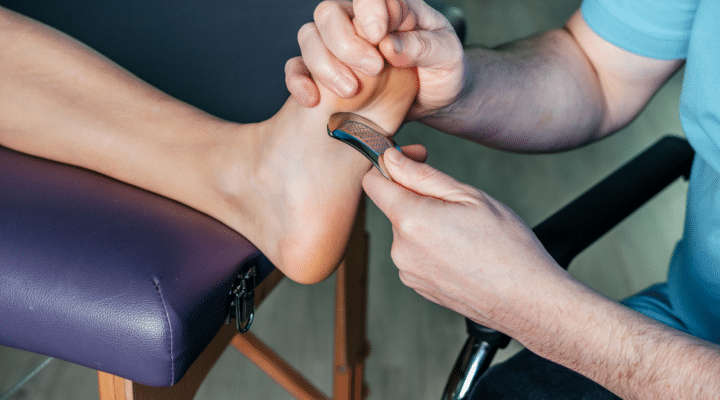
Additionally, manual therapy techniques can be employed to enhance tissue mobility and reduce pain. Soft tissue mobilization and joint mobilizations can be used to reduce stiffness and improve function.
4. Walking and mobility training
Most cases of plantar fasciitis are caused by an abnormal gait (walking or running motion). A physical therapist can evaluate your gait and suggest changes in your walking or running technique to relieve the stress on your plantar fascia.
Simply changing your posture or the way you walk can greatly reduce repetitive strain.
5. Taping and Orthotic Guidance
A tape job can help stabilize the arch for a short period of time, thus alleviating the pain during activities. A physical therapist can also assist with proper footwear or refer a patient to a podiatrist for custom or over-the-counter arch supports if needed.
How Long Does Recovery Take?
The duration of recovery depends on the severity of the condition and the duration of the symptoms. Mild conditions may recover within a few weeks of continuous treatment. Chronic conditions can take up to several months. Early treatment usually has more favorable outcomes and prevents the condition from progressing into a chronic condition.
Preventing Future Flare-Ups
Methods of prevention also play a role in physical therapy.,Your therapist may advise you to:
- Stretching exercises
- The principle of progressive overload
- Shoes that support your feet
- Foot and ankle stabiliser strengthening
- Steering clear of abrupt spikes in exercise
Consistency is crucial in avoiding relapse.
When to Get Help
Any heel pain that has not resolved after two or three weeks should be checked out. Left untreated, heel pain can lead to changes in the way you walk, which could affect your knees, hips, or lower back. By conducting a comprehensive examination, we can make a diagnosis as to whether plantar fasciitis is the cause of pain or if there is another pathology present.
Final Thoughts
Don’t let plantar fasciitis hold you back from enjoying the things you love. At Peake Physical Therapy, our dedicated team offers customized treatment programs to help alleviate pain, promote healing, and get you back to doing what you love. Schedule an appointment at Peake Physical Therapy and start your journey toward foot health and pain-free living.